
Crude oil prices behave much as any other commodity with wide price swings in times of shortage or oversupply. The crude oil price cycle may extend over several years responding to changes in demand as well as OPEC and non-OPEC supply.
The U.S. petroleum industry's price has been heavily regulated through production or price controls throughout much of the twentieth century. In the post World War II era U.S. oil prices at the wellhead averaged $24.98 per barrel adjusted for inflation to 2007 dollars. In the absence of price controls the U.S. price would have tracked the world price averaging $27.00. Over the same post war period the median for the domestic and the adjusted world price of crude oil was $19.04 in 2007 prices. That means that only fifty percent of the time from 1947 to 2007 have oil prices exceeded $19.04 per barrel. (See note in box on right.)
Until the March 28, 2000 adoption of the $22-$28 price band for the OPEC basket of crude, oil prices only exceeded $24.00 per barrel in response to war or conflict in the Middle East. With limited spare production capacity OPEC abandoned its price band in 2005 and was powerless to stem a surge in oil prices which was reminiscent of the late 1970s.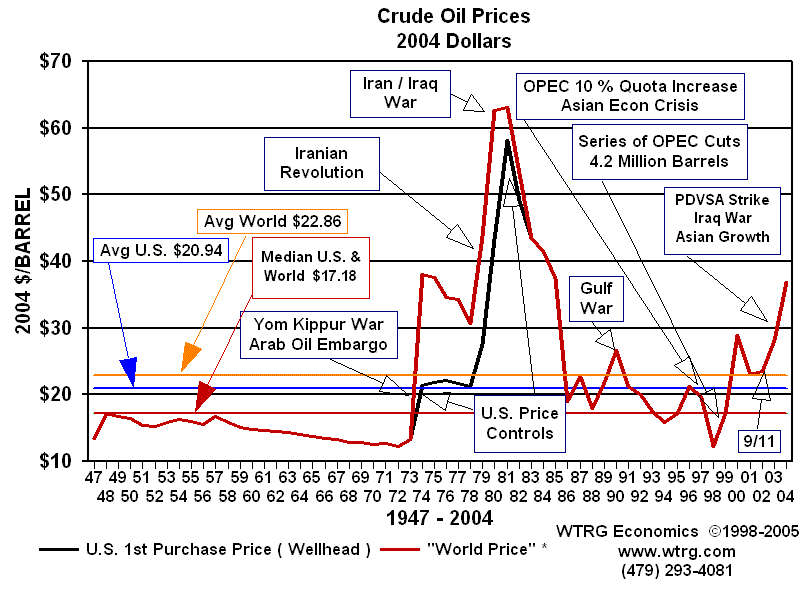
Click on graph for larger view
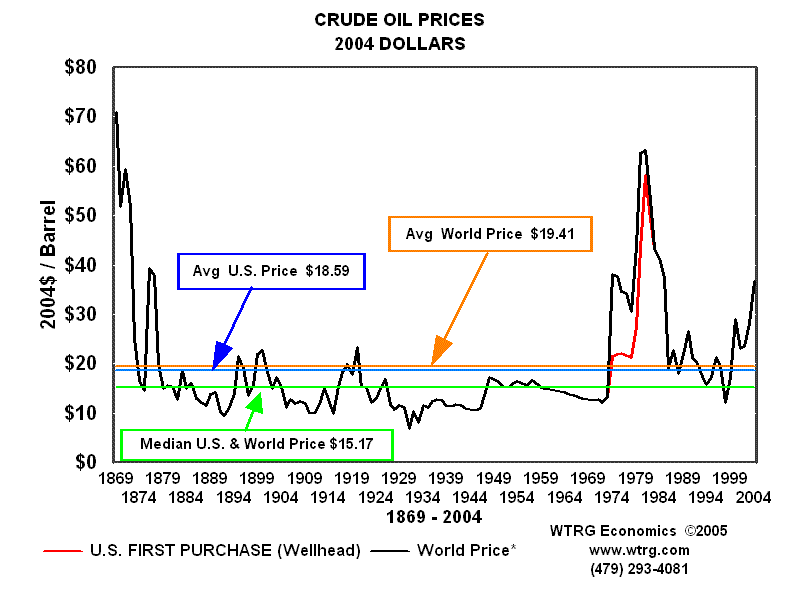
Crude Oil Prices 1869-2007
Click on graph for larger view
The very long term view is much the same. Since 1869 US crude oil prices adjusted for inflation have averaged $21.05 per barrel in 2006 dollars compared to $21.66 for world oil prices.
Fifty percent of the time prices U.S. and world prices were below the median oil price of $16.71 per barrel.
The results are dramatically different if only post-1970 data are used. In that case U.S. crude oil prices average $29.06 per barrel and the more relevant world oil price averages $32.23 per barrel. The median oil price for that time period is $26.50 per barrel.
If oil prices revert to the mean this period is likely the most appropriate for today's analyst. It follows the peak in U.S. oil production eliminating the effects of the Texas Railroad Commission and is a period when the Seven Sisters were no longer able to dominate oil production and prices. It is an era of far more influence by OPEC oil producers than they had in the past. As we will see in the details below influence over oil prices is not equivalent to control.


