
Great Scott, the Jet Pack Man Sets a World Speed Record!
 Powered by hydrogen peroxide, jet pack pilot Eric Scott has set a world speed record of 68 mph. In November 2008, I had talked about Scott setting a world record for distance and height in a hydrogen peroxide powered jet pack as he sailed 1,500 feet over a 1,000 feet abyss in Colorado.
Now, Scott actually broke the record three times over the weekend. This past Friday in Scotland, Eric Scott flying on behalf of Jet Pack International broke the record at 43 mph. Flying into a headwind on Saturday, Scott once again broke the record with a 54 mph attempt.
And, on Sunday, Scott thrilled the crowd with his final world record breaking mark of 68 mph. A traffic cop with a radar gun verified the results which have been submitted to Guinness for inclusion into their book of world records. There was no word as to whether Elton John’s “Rocket Man” song was playing for any of the attempts.
I’ve talked before about hydrogen peroxide as being potential fuel of the future for cars, planes, trains and other vehicles. Research is lacking in this area. But, the more attention that is called to this fuel by jetpack flyers and race car drivers will mean more needed research will be conducted in this important area.
Filed under: Hydrogen Vehicles | No Comments »
Obama and DOE Slash Hydrogen Car Budget by 60-percent
Just when I talked about how things weren’t as bad as they seemed a few days ago in regard to the federal hydrogen car budget, things have indeed gotten worse. On April 27, I talked about how the Department of Energy’s published budget in 2009, went down to $177.7 million from $211.9 million in 2008.
But, now in the past week, those numbers have changed on the DOE website. According to the current DOE site the numbers for 2009 are now up to $200,600 million for 2009. Now, the bad news.
According to the Wall Street Journal (WSJ), President Obama has asked the DOE to cut the hydrogen car budget for 2010 by 60-percent or roughly $100 million. According to the WSJ, the President sees hybrids, plug-ins and full electric cars as a better near term solutions than hydrogen cars.
The New York Times (NYT) seconds this sentiment saying that Energy Secretary Steven Chu said the government “preferred to focus on projects that would bear fruit more quickly.” The Wall Street Journal however blames the highball figure given by the National Research Council who said it would take $200 billion to build an adequate hydrogen refueling infrastructure (this figure is disputed in many of my past posts).
The WSJ also says, “A spokesman for the National Hydrogen Association in Washington said his group was still being briefed on the Obama proposal and had no immediate comment.”
Well, this is no longer the case as the National Hydrogen Association (NHA) has spoken out strongly against the hydrogen car budget cuts. In fact, the NHA and U. S. Fuel Cell Council offered a joint statement saying, “The cuts proposed in the DOE hydrogen and fuel cell program threaten to disrupt commercialization of a family of technologies that are showing exceptional promise and beginning to gain market traction.
“Fuel cell vehicles are not a science experiment. These are real vehicles with real marketability and real benefits. Hundreds of fuel cell vehicles have collectively logged millions of miles.
“Both the National Academy of Sciences and NHA’s recent Energy Evolution report conclude that a portfolio of vehicle technologies is needed to achieve the nation’s energy and environmental security goals and that hydrogen is essential to success. Hydrogen also advances the Obama Administration’s goals of greener power generation and a smarter power grid.”
Well, so much for reaching across the aisle when it comes to hydrogen car technology. With this kind of deep budget cut looming for hydrogen cars, the delayers and deniers (and we’re not talking about climate change - or are we?) have taken over in the new administration. Let’s hope a more rational approach takes over in the months to come in regard to clean car technology and energy independence for this country. And let’s also hope this is not simply a political move to undo more of the Bush policies of the past.
Filed under: Political Issues | No Comments »
Ronn Motors - FedEx, Federal Incentives and the Chinese
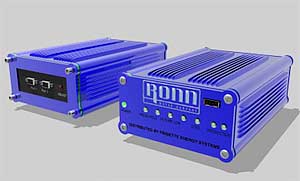 Ronn Motors, the makers of the eco supercar Ronn Scorpion and the H2GO hydrogen fuel injection system have been hitting the publicity trail lately by striking deals with FedEx, hoping to strike deals with our Federal Government and making friends with the Chinese in hopes of future financial gains.
First on the agenda is the news that a contractor for FedEx is doing a field trial on Ronn Motors’ H2GO system for increasing mileage on delivery trucks and reducing emissions. The H2GO system is currently installed on two 18-wheeler trucks and results will be tracked for the next 30 days. If the results are positive, then the H2GO is expected to be installed in a number of regular FedEx vehicles.
In other news, Ronn Motors has retained the Potomac Strategic Development Group to lobby the Federal Government in Washington DC for grants and direct loans under President Obama’s stimulus package. Of particular interest is the money put aside by the Fed for development of green cars and leading edge energy technology.
But, that’s not all. In another month, representatives from Ronn Motors and Frigette Energy Systems will be traveling to China to demonstrate the H2GO technology to several Chinese automakers and automotive laboratories in Beijing. The total number of cars in China is expected to exceed those in the U. S. by 2020 and Chinese automobiles are the single biggest contributor to pollution in that country even outpacing coal fired power plants.
Whether or not you believe that the H2GO technology is viable, one thing is for certain. We will find out soon enough whether Ronn Motors’ putting their money where their mouth is will result in a belly full of cash or Ronn Maxwell eating crow. There isn’t much room in-between these two extremes.
Filed under: Hydrogen Gas Savers | 2 Comments »
Chengli Hung’s Fuel Cell Scooter Concept
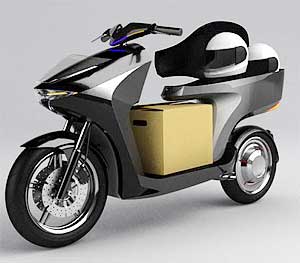 She-bangs, She-bangs, Oh baby, when she moves, she moves. Okay, sorry, that is William Hung from American Idol and not Chengli Hung. Chengli Hung may not have the artistry (questionable at best) to sing and dance like William but what he does have is the artistic and mechanical ability to put forth an interesting hydrogen fuel cell scooter concept.
As one can see by the picture this scooter is not like many others in its class. Besides having the fuel cell and controller integrated on the bottom underneath the enlarged floorboard, just above this is an expanded storage area as well. The scooter is meant for in city driving and will most likely appeal to the younger population who want to get from point A to B without the hassle of a car.
Now, security with this fuel cell vehicle is paramount since the scooter may be left for hours without anyone attending it. So, this is why Chengli Hung decided to make the fuel cell and controller removable, so that a person could take it with them into the coffee house or at work if needed.
The luggage compartment in the back is big enough to contain two large helmets and integrated into the handles are screens that deliver images from fisheye cameras mounted in the rear and on the sides for optimal visibility. And, the best part is, since this is a fuel cell vehicle, this scooter don’t bang, she don’t bang like an internal combustion engine scooter does.
Filed under: Hydrogen Vehicles | No Comments »
2015 Honda CB 750 Hydrogen Motorcycle Concept Unveiled
 Forget the green car of the year, Honda FCX Clarity for a minute. The 2015 Honda CB 750 Hydrogen Motorcycle Concept has been unveiled.
The Honda CB 750 is equipped with a four-cylinder engine that burns liquid hydrogen and emits on water. Since toughness and lightness is a premium for any powerful, yet green motorcycle, the vehicle’s body and frame use a combination of aluminum, titanium and carbon fiber.
On the fuel tank there is a multi-touch OLED display that controls such functions as Diagnostics, GPS and Drive Modes. The hydrogen motorcycle also boasts a six-speed transmission with traction and electronic lurch control.
Now, I had talked about the Suzuki Crosscage in October 2007 as a contender in the hydrogen-powered motorcycle category. But the Crosscage is a fuel cell vehicle powered by compressed hydrogen gas.
The Suzuki Crosscage and 2015 Honda CB 750 Hydrogen Motorcycle will appeal to different markets and presumably compete over hydrogen refueling infrastructure as well. Whether fuel cell or ICE, both Honda and Suzuki are putting out some pretty cool bikes that will make a consumer “Born to Be Wild” and an “Easy Rider” at the same time.
Filed under: Hydrogen Vehicles | No Comments »
Mazda RX-8 RE Hydrogen Cars Arriving in Norway
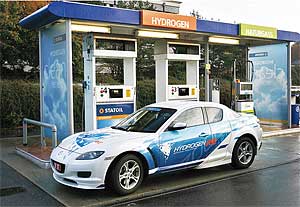 It’s been a long time coming. In November 2007 I had talked about Mazda planning to deliver 30 to 40 Renesis RX 8 Hydrogen cars to Norway as part of the region’s Hynor project. Now, Mazda is making good on this promise in short order.
On May 11, 2009 just one week from today, Mazda is scheduled to deliver its first Mazda RX-8 RE Hydrogen car at Hynor’s official opening. The cities in the 360-mile stretch of Norway that hydrogen fueling stations will be operational include Oslo, Drammen, Notodden, Porsgrunn, Grimstad, Lyngdal and Stavanger.
Once the ribbon cutting ceremony has concluded in Oslo, the Mazda RX-8 Hydrogen will need to undergo Norwegian certification to make sure it passes all road standards in that country. The Mazda RX-8 RE Hydrogen is currently being leased in Japan and is different from most H2 fuel cell vehicles.
The Mazda RX-8 RE Hydrogen uses a dual fuel rotary internal combustion engine plus transmission to motivate the vehicle. With a flip of a switch the driver can go between hydrogen power and gasoline as needed.
Mazda first developed the hydrogen rotary engine back in 1991 and has since refined the hydrogen engine and has developed hydrogen fuel cell vehicles as well (Demio FC-EV, Premacy FC-EV). The Mazda RX-8 RE Hydrogen is slated to start leasing in Norway this coming summer 2009.
Filed under: Hydrogen Cars | No Comments »
National Hydrogen Association Report on Positive Growth for H2 Cars
The National Hydrogen Association has come out with a document called the “Energy
Evolution: An Analysis of Alternative Vehicles and Fuels to 2100.” In this document is a comparison of 15 vehicle and fuel alternatives that can cut greenhouse gases and provide energy independence from now to the turn of the century.
The document of course doesn’t promote hydrogen as the only solution but one of several solutions (albeit the primary solution) going forward that will provide cleaner air and energy self-reliance plus provide a refueling medium in which consumers are familiar.
According to the Energy Evolution report, hydrogen fuel cell vehicles, plug-in hybrids, other hybrids and biofuel vehicles could cut emissions 80-percent below 1990 levels, eliminating almost all controllable urban air pollution.
The document states that building a nationwide hydrogen fueling infrastructure of 6,500 pumps would cost around $9 billion. This dollar amount is far less than critics and naysayers who typically quote $500 billion or more in costs.
But, consider this. A hydrogen fuel cell vehicle is two to three times more efficient that a typical gasoline powered engine. So, in other words, while a gasoline internal combustion engine (ICE) may be getting 25 mpg, a hydrogen FCV may get between 50 mpg to 80 mpg and beyond.
Now, add to this scenario a plug-in hydrogen FCV and the MPG’s may go over 100, which is quite feasible in time. With FCV’s getting over 100 mpg the current gasoline infrastructure won’t have to be replicated. Far fewer hydrogen pumps will need to be put in place to accommodate the current amount of cars we have on the road.
The report says that hydrogen can be produce domestically from natural gas at first, then transitioned to renewable resources, the cleanest means of producing fuel. Producing hydrogen from water and wind, solar, geothermal or hydroelectric would provide clean well to wheel technology.
In order to achieve these goals, however, more investment is needed now. Most investment will come in the private sector, by government plus incentives for business and consumers.
The NHA Energy Evolution report shows a bright future for hydrogen cars and vehicles, if the political will is in place. So, let your congressional representatives, governors and President know that hydrogen is the right pathway to take in this country.
Filed under: Advocates | 1 Comment »
1966 GM Electrovan and Electrovair and Other Reader Opinions
Justin G. visited the main Hydrogen Cars website recently and sent in a lot of his opinions about different topics that he would like to share:
“I was surfing your site and couldn’t help but notice on your page about the 1966 GM Electrovan you mention that the setup used to power the vehicle was originally intended to go into the 1966 GM Electrovair. I’m not trying to dispute this information, I just figured I’d mention the fact that the 1966 GM Electrovair was indeed an actual vehicle made by Chevrolet. The vehicle wasn’t powered by hydrogen, but was in fact powered by a 100HP electric motor. I’m not sure if the car was originally designed to be powered by hydrogen or not, but I think it would be a cool addition to your page if you added that the 1966 Electrovair was indeed built using fully electric propulsion. The car doesn’t need it’s own page devoted to it (Especially seeing as how it’s not hydrogen powered) but it would be nice to see the car get some recognition.
“Honda and Toyota seem to get all the credit in the alternative fuel market, I just think it’s time for people to realize that these are not new concepts, and that most were actually introduced as concepts by American manufacturers over 4 decades ago. The same goes for modern fuel injection systems, which made their first widespread appearance in diesel engines, then were adapted to gasoline engines by Alfa Romeo. Bosch made the fuel injection systems put in Mercedes Benz vehicles in 1955. Even Chevrolet had a fuel injection system by 1957. In 1958, Chrysler developed the first form of “Electronic” (If you could even call it that) fuel injection on their line of HEMI engines, yet Japanese companies who mass produced such technologies still seem to take all the credit.
“Anyhoo… I just hated when Toyota got all the credit for making a “Semi-Electric” car (The Prius), when Chevrolet had a fully electric concept in 1966. It broke my heart to see Honda take credit for the first hydrogen fuel cell vehicle (FCX Clarity) when, again, Chevy had similar (Albeit primitive) technology in 1966.
“I guess the import market does deserve credit for creating such vehicles worthy of mass production and marketing to the public, but I hate to see the efforts of our own domestic manufacturers go unnoticed, especially since their achievements over 40 years ago were so advanced for their time. This raises the question, what happened to us that we abandoned such ideas so long ago?
If these companies had invested a little more time, effort, and money into these projects years ago, we would’ve been driving electronic fuel injected V8’s in 1965, hybrids by 1975, electric cars by 1980, and probably hydrogen powered vehicles by 1985. Man, where did we go wrong….. My guess would have to be big oil companies and their big wallets keeping these technologies at bay until people finally got fed up with the gas prices…. Enter, stage left, the Japanese automobile market……”
Agree or disagree, Justin G. lays it all out there and perhaps a few more people would like to add their comments to this thread as well.
Filed under: Hydrogen Cars | No Comments »
Even If Bankrupt GM is High on Hydrogen Cars
Even if auto giant General Motors goes into bankruptcy they still see their future survival tied to hydrogen cars. GM continues to parade its Chevy Equinox Fuel Cell SUV, which made an appearance in Tonawanda, New York recently.
And on May 15, 2009, GM plans to have a ride and drive day for its Chevy Equinox Fuel Cell in Southern California for members of its Project Driveway team. The problem for hydrogen car makers has always been a lack of supporting fueling stations nationwide.
But, according to Daniel O’Connell, GM’s director of fuel cell commercialization, “… the United States already produces enough hydrogen to run 130 million fuel cell cars each year, and that more than half of that hydrogen is used to remove sulfur from gasoline. If that gasoline is no longer needed, the hydrogen would be available to fuel cars and other machines.”
So, in a nutshell, there is no shortage of hydrogen in the U. S. right now. What we need to do it redirect the H2 from the refineries to the fueling stations. Hopefully GM will be around long enough to see this transition happen.
Filed under: Hydrogen Cars | 1 Comment »
Linde Double Dipping Producing Hydrogen from Biodiesel Byproduct
The Linde Group has decided that double dipping will increase their revenues when creating alternative fuels of the future. In Leuna, Germany, the Linde Group is setting up a plant that will produce biodiesel first and then use the glycerin byproduct to produce hydrogen for cars.
The hydrogen will then be purified and liquefied at cryogenic temperatures and dispensed in towns like Hamburg and Berlin, which already have hydrogen fueling stations online. Presumably cars like the BMW Hydrogen 7 will refuel at these stations.
Glycerin made from biogenic raw materials (plants) is an excellent feedstock for hydrogen since glycerin contains eight hydrogen atoms. Of course there is no word yet on what Linde intends to do with the 3 carbon atoms in the glycerin when it is processed and reformed.
The production of hydrogen from glycerin will help supply the growing European Hydrogen Highway system and support Germany’s current 26 hydrogen refueling stations (equal to the number in California).
If Linde can use plant feedstock and double dip on its production of alternative fuels, there are likely many other manufacturers chomping at the bit to get onboard as well. Double dipping may be a social faux pas but in business, it just makes good sense.
Filed under: Hydrogen Production | No Comments »


